Showing posts with label This Week In Chemistry. Show all posts

Wednesday, July 12, 2023

YOU CAN HAVE ADVENTURES

Students and Parents:

Looking ahead to the coming academic year, what should you expect from science coursework?  What's the point of taking science, anyway?  Where could studying Biology, Chemistry or Physics ultimately take you?

Back in 2016, I was the subject of a profile by local news station KSEE 24.   They had learned some things about my career as a science teacher, and they were intrigued by how I answered questions like that.  

It may seem corny, but the truth is that learning can be an intellectual adventure---a 'voyage of the mind'----and the results of that learning can lead to actual physical adventures!


HOW?


Monday, May 1, 2023

Thursday, March 23, 2023

VIDEO: ACID-BASE EQUILIBRIUM

Students should have been given the worksheet based on this video prior to Spring Break.  In the video, Paul Andersen demonstrates the centrality of water to most acid-base chemistry, and explains how to calculate equilibrium constants for acids (Ka) and bases (Kb), and how to express those as pKa's or pKb's:


Monday, March 20, 2023

POWER POINT NOTES: CHEMICAL KINETICS


Students, here are the Power Point Notes on Chemical Kinetics, which covers the concept of equilibrium and the rates of reaction.


The Study Guide has been made available in class since Friday, March 17th.  If you need to get another copy, you can download a PDF version of the Study Guide HERE.

UNIT 6 is now over, and all Unit 6 work is PAST DUE, and will NOT be accepted after Friday,  March 24th  


VIDEO: EQUILIBRIUM

In this video, Paul Anderson does a great job of providing a demonstration that suggests how chemical systems reach equilibrium.


Mr. Anderson also models how to equilibrium setups and solve for the value of the equilibrium constant, 'K'.  Students were given a worksheet based on this video in Friday's class, along with a set of problems in which they will practice setting up equilibrium expressions.

This is a short topic, and the notes on Chemical Kinetics should be finished within the same day as viewing the video.  Both items should be treated as homework, and completed as soon as possible.


Friday, January 13, 2023

VIDEO: SOLUTIONS

Students can watch Paul Andersen's discussion of solutions and their properties as many times as needed here, on-line, in the video embedded below:


Students can also access the PDF version of the worksheet given in class, based on this video, HERE.

Tuesday, January 10, 2023

UNIT 5 SYLLABUS: STOICHIOMETRY OF FLUIDS

Students: here is the current Syllabus for Unit 5, beginning the Spring Semester.  Please note that all students are expected to review and demonstrate competency in the math routines rehearsed in the Fall Semester, and that students may be expected to attend Saturday School on Saturday, January 21st, if they are deficient.  


Monday, December 5, 2022

VIDEO: LIMITING REACTANTS and PERCENT YIELD

Students, here is the video shown in class on Monday and Tuesday to support mastery of the (titular) concepts.   Problems like this will be found on your FINAL (Dec. 13th-15th).


Wednesday, November 30, 2022

VIDEO: STOICHIOMETRY

Students, as with 'The Mole', I am making this Paul Andersen video available through the class blog.   Please watch as many times as you need:


The worksheet based on this video is available online HERE:

Friday, November 18, 2022

POWER POINT: The Conversion Experience, Part 2

STUDENTS: Clink on THIS LINK to find material on chemical reactions, balancing equations and stoichiometry.  

Use this to complete your Unit 4 Study Guide, 'The Conversion Experience', which will form the basis of your personalized Unit 4 Notes in your Composition Book.


Monday, November 14, 2022

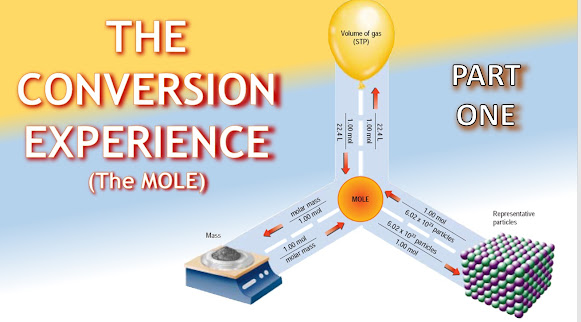
POWER POINT: THE CONVERSION EXPERIENCE, PART 1

STUDENTS:   Here is the first part of
"The Conversion Experience" Study Guide
shared in Mr. Hatfield's classes on Thursday and Monday.   

This set of notes reviews the concept of the mole and the molar mass, as well as unit conversions for moles to grams and moles to particles, then introduces the concept of the molar volume (22.4 L/mol at STP).


Thursday, November 3, 2022

VIDEO: FIREWORKS!

Students who were in Mr. Hatfield's classes on Friday, Nov. 4th, watched a PBS video entitled 'Fireworks!'  Students who need to watch it again, or who were not present on Friday, will find the video embedded below in this post.

The worksheet for this video can be obtained HERE.

Students should pay careful attention to items related to their text, including Section 4.2, pg. 110-127 (electron configuration) and Section 6.5, pg. 185-190 (ionic compounds):


Monday, October 31, 2022

POWER POINT NOTES: "THE ELEMENTAL PATTERN" and "THE COSMIC FINGERPRINT"

Students:  Here are the TWO sections of Power Point Notes for Unit 3, 'The Cosmic Fingerprint'.

First, we have 'The Elemental Pattern', that shows how the periodic table contains deep information about the structure of the different elements:


Next, we have 'The Cosmic Fingerprint', that shows that the arrangement of electrons in the shells of atoms is related to an element's 'signature' of energy levels, which in turn can be used to explain the chemical properties of that element:


The Unit 3 Test is November 8th!

You should be using these slides to complete your Unit 3 Study Guides of the same title.   

Those Study Guides should be handed in before the beginning of Tuesday's class in order to ensure that you have plenty of time to create your personalized, detailed copy of the notes in your Composition Book.


Tuesday, October 18, 2022

VIDEO: THE BUNSEN BURNER

Mr. Hatfield has made a video to demonstrate the correct way to use the Bunsen burner.  Make sure you review this before you come to class on Monday, as we will be using the Bunsen burners in class to perform the flame test lab.


Wednesday, October 12, 2022

VIDEO: BRIGHT LINE SIMULATION DEMO

In this video, Mr. Hatfield models how to use the on-line simulation that is part of our 'Bright Line Spectra' introduced in Friday's class.

The simulation itself can be found HERE.


Monday, October 10, 2022

POWER POINT NOTES: The Elemental Pattern

STUDENTS: This Power Point supports the notes on the periodic table, focusing especially on periodic trends related to the electron configuration of the different elements.  


Use this information to complete your Study Guide, which will form PART of the basis of your Unit 3 Notes.  (There will be a SECOND Study Guide in this Unit).

Tuesday, September 27, 2022

POWER POINT NOTES: THE FLAVORS OF MATTER

Students:  HERE are the revised Power Point Notes for Unit 2, 'The Flavors of Matter'.


The Unit 2 Test is

Tuesday, October 4th!

You should be using these slides to complete your Unit 2 Study Guide of the same title.   

That Study Guide should be handed in before the beginning of Thursday's class in order to ensure that you have plenty of time to create your personalized, detailed copy of the notes in your Composition Book.


Monday, September 26, 2022

UPDATE: UNIT 2 SYLLABUS

STUDENTS: due to the disruption of classes caused by both alarms and attendance, Mr. Hatfield is revising the present Unit Syllabus.  

Four items have been removed, and about half of the remaining assignments have been reordered.  

Please notice, however, that you are STILL expected to hand in your completed Unit 2 Study Guide this week, and you are STILL expected to take your Unit 2 exam on Tuesday, October 4th.


Thursday, September 22, 2022

VIDEO: 'THE LIVES OF THE STARS'

;

The following episode of Carl Sagan's Cosmos, 'The Lives of the Stars', forms the basis of a student homework assignment given in class on Friday, September 23rd.


  It can be viewed on-line currently HERE.

VIDEO: 'DRAWING ATOMS, HATFIELD STYLE'

In this VIDEOMr. Hatfield demonstrates his flat, two-dimensional, cartoony and unrealistic way to draw atoms. But that's not a bad thing.

Atoms don't 'look like' anything in the real world, so every attempt to draw them is going to be unrealistic in some sense: they're smaller than visibile light, after all!

But, Mr. Hatfield's way of drawing atoms does allow you to distinguish at a glance between the internal structure of a standard neutral atom, an ion or an isotope---and that can make all the difference in understanding the way that different substances (elements and compounds) actually behave.