In Thursday's class, we talked about the difference between organic (based on carbon) and inorganic (based on some other element) molecules. Life, of course, is based on organic molecules.
There are four major classes of carbon-based compounds used by living things: carbohydrates, lipids, proteins and nucleic acids.
Each of these compounds is made of individual 'building blocks' called MONOMERS. The monomers are linked together with covalent bonds to make large chains called POLYMERS, and the process of making polymers is referred to as POLYMERIZATION.
Here's a video from Bozeman Science, with animations, that gives some nice background on monomers and polymers:
Carbohydrates are carbon-based macromolecules based on C, H and O. They are polar and readily dissolve in water.
A simple sugar by itself, like glucose, is termed a monosaccharide, and serves as a 'building block' (monomer) to build a larger chain of many molecules called a polymer. In the case of carbohydrates, the polymer made from many monosaccharides linked together by dehydration reactions is called a polysaccharide.
Examples of polysaccharides made of glucose include cellulose, glycogen and starch. Each of these glucose polymers are biologically important.
Finally, here's yet another video by AP Chemistry teacher Paul Andersen, this on the class of macromolecules called PROTEINS.
PROTEINS often are used to build extremely useful and specific molecules called ENZYMES:

Showing posts with label 2017-2018 Chemistry Videos. Show all posts
Showing posts with label 2017-2018 Chemistry Videos. Show all posts
Friday, May 4, 2018

Sunday, April 15, 2018
VIDEO: OXIDATION REDUCTION REACTIONS
Tyler DeWitt has made a very handy, easy-to-understand video that uses the formation of an ionic compound (NaCl, sodium chloride) to illustrate the logic of oxidation-reduction reactions, sometimes called 'redox' reactions, as described in Chapter 20.
Tyler not only gives an example of oxidation numbers (20.2), but he also shows how to to use these numbers to describe 'half-reactions' (20.3)
While there is no worksheet based upon this video, this is highly-similar to how students will be introduced to these concepts in Lecture, and is worth repeated viewings:
Tyler not only gives an example of oxidation numbers (20.2), but he also shows how to to use these numbers to describe 'half-reactions' (20.3)
While there is no worksheet based upon this video, this is highly-similar to how students will be introduced to these concepts in Lecture, and is worth repeated viewings:
Wednesday, April 4, 2018
VIDEO: ACID-BASE EQUILIBRIUM
Students were shown this video in today's class. Paul Andersen demonstrates the centrality of water to most acid-base chemistry, and explains how to calculate equilibrium constants for acids (Ka) and bases (Kb), and how to express those as pKa's or pKb's:
Friday, February 23, 2018
VIDEO: ENTHALPY OF REACTIONS
The following video by Paul Anderson was introduced in class on Thursday, Feb. 23rd. It helpfully reviews some of the information already given in lecture regarding heat and the enthalpy of reactions. It also features a very handy, step-by-step demonstration of how to apply Hess's Law (a SUBTLE and advanced topic) to calculate enthalpies.
Students have an assignment based on that video, which is available HERE as a PDF file.
Students have an assignment based on that video, which is available HERE as a PDF file.
Thursday, January 25, 2018
VIDEO: GASES
Paul Anderson helps us out again. This video has a great set of demonstrations using a set of interactive animations. Students are expected to complete a worksheet based on this video:
The simulation that Mr. Anderson uses in the video can be accessed online, at the University of Colorado, HERE:
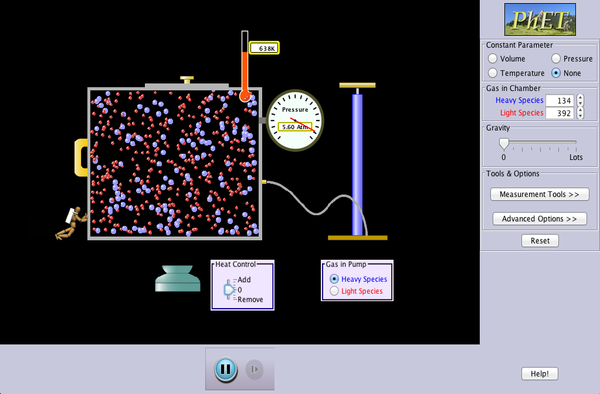
The simulation that Mr. Anderson uses in the video can be accessed online, at the University of Colorado, HERE:
| Click to Run |
Friday, January 12, 2018
VIDEO: TEMPERATURE
As we begin our notes on the 'Kinetic Theory of Gases', it is important to realize that the random, dynamic motion of a very large set of tiny (sub-MICROSCOPIC) particles produces the phenomena we can observe at our own, relatively large (MACROSCOPIC) scale, like pressure and temperature.
Paul Anderson demonstrates this in the following video. Students will receive an accompanying worksheet based upon it!
Paul Anderson demonstrates this in the following video. Students will receive an accompanying worksheet based upon it!
Friday, December 1, 2017
VIDEO: SOLUTIONS
Students can watch Paul Andersen's discussion of solutions and their properties as many times as needed here, on-line, in the video embedded below:
Students can also access the PDF version of the worksheet given in class, based on this video, HERE.
Students can also access the PDF version of the worksheet given in class, based on this video, HERE.
Wednesday, November 1, 2017
VIDEO: "STOICHIOMETRY"
Students, as with 'The Mole', I am making this Paul Andersen video available through the class blog. Please watch as many times as you need:
The worksheet based on this video is available online HERE:
The worksheet based on this video is available online HERE:
Wednesday, October 18, 2017
VIDEO: THE MOLE
Students: here is Paul Anderson's video, as shown in Thurdsay's class, explaining the concept of the mole with helpful illustrations:
Student should use this video to complete a worksheet given in class, which is also available online HERE.
Student should use this video to complete a worksheet given in class, which is also available online HERE.
Tuesday, October 10, 2017
FLAME TEST LAB
If students were absent on the day we were guests in Mr. Diaz's classroom, they did not get to see the actual lab where we performed a 'flame test' on various ionic compounds.
Here is a video that shows much the same sort of observations students made on Wednesday. Unfortunately, we do not have Bunsen burners in my classroom, and so it is not practical to 'make up' the lab. Watch the video, students, and compare it with observations that students who attended were able to make in order to understand the material:
Here is a video that shows much the same sort of observations students made on Wednesday. Unfortunately, we do not have Bunsen burners in my classroom, and so it is not practical to 'make up' the lab. Watch the video, students, and compare it with observations that students who attended were able to make in order to understand the material:
Monday, September 18, 2017
VIDEO: THE BUNSEN BURNER
Mr. Hatfield has made a video to demonstrate the correct way to use the Bunsen burner. Make sure you review this before you come to class on Tuesday, as we will be using the Bunsen burners in Mr. Diaz's classroom to perform the flame test lab.
Tuesday, September 12, 2017
VIDEO: FIREWORKS!
Students who were in Mr. Hatfield's classes on Tuesday, Sept. 12th, watched a PBS video entitled 'Fireworks!' Students who need to watch it again, or who were not present on Tuesday, will find the video embedded below in this post.
The worksheet for this video can be obtained HERE.
Students should pay careful attention to items from Chapter 5 (electron configuration) and Chapter 7 (ionic compounds):
The worksheet for this video can be obtained HERE.
Students should pay careful attention to items from Chapter 5 (electron configuration) and Chapter 7 (ionic compounds):
Friday, September 1, 2017
VIDEO: THE LIVES OF THE STARS

The following episode of Carl Sagan's Cosmos, 'The Lives of the Stars', forms the basis of a student homework assignment given in class on Friday, September 1st.
This can be viewed on-line at: https://www.youtube.com/watch?v=vDD8TLU9J6c
Subscribe to:
Posts (Atom)