Previously, we talked about the difference between organic (based on carbon) and inorganic (based on some other element) molecules. Life, of course, is based on organic molecules.
There are four major classes of carbon-based compounds used by living things: carbohydrates, lipids, proteins and nucleic acids.
Each of these compounds is made of individual 'building blocks' called MONOMERS. The monomers are linked together with covalent bonds to make large chains called POLYMERS, and the process of making polymers is referred to as POLYMERIZATION.
Here's a video from Bozeman Science, with animations, that gives some nice background on monomers and polymers:
Carbohydrates are carbon-based macromolecules based on C, H and O. They are polar and readily dissolve in water.
A simple sugar by itself, like glucose, is termed a monosaccharide, and serves as a 'building block' (monomer) to build a larger chain of many molecules called a polymer. In the case of carbohydrates, the polymer made from many monosaccharides linked together by dehydration reactions is called a polysaccharide.
Examples of polysaccharides made of glucose include cellulose, glycogen and starch. Each of these glucose polymers are biologically important.
Finally, here's yet another video by AP Chemistry teacher Paul Andersen, this on the class of macromolecules called PROTEINS.
PROTEINS often are used to build extremely useful and specific molecules called ENZYMES:

Showing posts with label 2018-2019 Chemistry Videos. Show all posts
Showing posts with label 2018-2019 Chemistry Videos. Show all posts
Wednesday, May 8, 2019

Wednesday, April 24, 2019
VIDEO: "NAMING COMPOUNDS"
In this handy video, Paul Anderson reviews the basic rules for ionic and covalent bonding. Students should compare this video with their 'Nomenclature Review' handout, as well as the (ionic) version of the periodic table on the back of their Unit 8 syllabus.
Thursday, March 28, 2019
VIDEO: 'REDOX' REACTIONS
Tyler DeWitt has made a very handy, easy-to-understand video that uses the formation of an ionic compound (NaCl, sodium chloride) to illustrate the logic of oxidation-reduction reactions, sometimes called 'redox' reactions, as described in Chapter 20.
Tyler not only gives an example of oxidation numbers (20.2), but he also shows how to to use these numbers to describe 'half-reactions' (20.3)
While there is no worksheet based upon this video, this is highly-similar to how students will be introduced to these concepts in Lecture, and is worth repeated viewings:
Tyler not only gives an example of oxidation numbers (20.2), but he also shows how to to use these numbers to describe 'half-reactions' (20.3)
While there is no worksheet based upon this video, this is highly-similar to how students will be introduced to these concepts in Lecture, and is worth repeated viewings:
Monday, March 18, 2019
VIDEO: ACID-BASE EQUILIBRIUM
Students were shown this video in Friday's class. Paul Andersen demonstrates the centrality of water to most acid-base chemistry, and explains how to calculate equilibrium constants for acids (Ka) and bases (Kb), and how to express those as pKa's or pKb's:
Friday, March 8, 2019
VIDEO: EQUILIBRIUM
In this video, Paul Anderson does a great job of providing a demonstration that suggests how chemical systems reach equilibrium.
Mr. Anderson also models how to equilibrium setups and solve for the value of the equilibrium constant, 'K'. Students were given a worksheet based on this video in Friday's class, along with a set of problems in which they will practice setting up equilibrium expressions.
This is a short topic, and the notes on Chemical Kinetics were also finished. Both items should be treated as homework, and completed as soon as possible.
Mr. Anderson also models how to equilibrium setups and solve for the value of the equilibrium constant, 'K'. Students were given a worksheet based on this video in Friday's class, along with a set of problems in which they will practice setting up equilibrium expressions.
This is a short topic, and the notes on Chemical Kinetics were also finished. Both items should be treated as homework, and completed as soon as possible.
Wednesday, January 30, 2019
VIDEO: GASES
Paul Anderson helps us out again. This video has a great set of demonstrations using a set of interactive animations. Students are expected to complete a worksheet based on this video:
The simulation that Mr. Anderson uses in the video can be accessed online, at the University of Colorado, HERE:
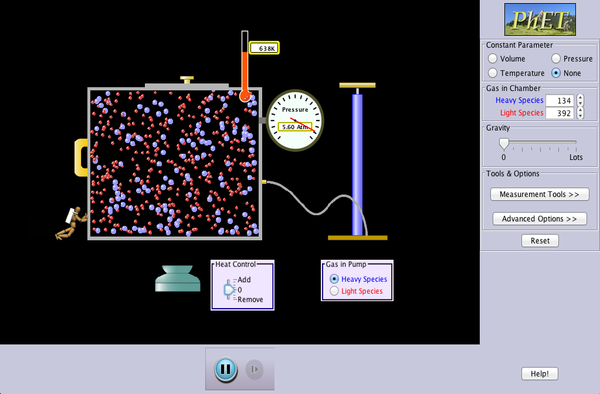
The simulation that Mr. Anderson uses in the video can be accessed online, at the University of Colorado, HERE:
| Click to Run |
Friday, January 11, 2019
VIDEO: TEMPERATURE
As we begin our notes on the 'Kinetic Theory of Gases', it is important to realize that the random, dynamic motion of a very large set of tiny (sub-MICROSCOPIC) particles produces the phenomena we can observe at our own, relatively large (MACROSCOPIC) scale, like pressure and temperature.
Paul Anderson demonstrates this in the following video. Students will receive an accompanying worksheet based upon it!
Paul Anderson demonstrates this in the following video. Students will receive an accompanying worksheet based upon it!
Tuesday, December 4, 2018
VIDEO: SOLUTIONS
Students can watch Paul Andersen's discussion of solutions and their properties as many times as needed here, on-line, in the video embedded below:
Students can also access the PDF version of the worksheet given in class, based on this video, HERE.
Students can also access the PDF version of the worksheet given in class, based on this video, HERE.
Tuesday, November 27, 2018
VIDEO: LIMITING REACTANTS and PERCENT YIELD
Students, here is the video shown in class on Tuesday and Wednesday to support mastery of the (titular) concepts:
Wednesday, November 7, 2018
VIDEO: STOICHIOMETRY
Students, as with 'The Mole', I am making this Paul Andersen video available through the class blog. Please watch as many times as you need:
The worksheet based on this video is available online HERE:
The worksheet based on this video is available online HERE:
Monday, October 29, 2018
VIDEO: THE MOLE
Students: here is Paul Anderson's video, as shown in Tuesday's class, explaining the concept of the mole with helpful illustrations:
Student should use this video to complete a worksheet given in class, which is also available online HERE.
Student should use this video to complete a worksheet given in class, which is also available online HERE.
Thursday, October 4, 2018
VIDEO: FLAME TEST LAB
If students were absent on the day we were guests in Mr. Fischer or Mr. Diaz's classroom, they did not get to see the actual lab where we performed a 'flame test' on various ionic compounds.
Here is a video that shows much the same sort of observations students made on Wednesday or Thursday. Unfortunately, it is not practical to 'make up' the lab, due to the work that still needs to be done to bring N-25 'up to speed'. Watch the video, students, and compare it with observations that students who attended were able to make in order to understand the material:
Here is a video that shows much the same sort of observations students made on Wednesday or Thursday. Unfortunately, it is not practical to 'make up' the lab, due to the work that still needs to be done to bring N-25 'up to speed'. Watch the video, students, and compare it with observations that students who attended were able to make in order to understand the material:
Friday, September 28, 2018
VIDEO: THE BUNSEN BURNER
Mr. Hatfield has made a video to demonstrate the correct way to use the Bunsen burner. Make sure you review this before you come to class on Monday, as we will be using the Bunsen burners in class to perform the flame test lab.
VIDEO: FIREWORKS!
Students who were in Mr. Hatfield's classes on Friday, Sept. 28th, watched a PBS video entitled 'Fireworks!' Students who need to watch it again, or who were not present on Fruday, will find the video embedded below in this post.
The worksheet for this video can be obtained HERE.
Students should pay careful attention to items from Chapter 5 (electron configuration) and Chapter 7 (ionic compounds):
The worksheet for this video can be obtained HERE.
Students should pay careful attention to items from Chapter 5 (electron configuration) and Chapter 7 (ionic compounds):
Friday, August 31, 2018
VIDEO: 'THE LIVES OF THE STARS'

The following episode of Carl Sagan's Cosmos, 'The Lives of the Stars', forms the basis of a student homework assignment given in class on Friday, August 31.
The entire episode is available for students to watch, as needed, HERE:
https://www.youtube.com/watch?v=xrmM51Kldv0
Friday, August 17, 2018
VIDEO: COSMIC VOYAGE
Chemistry students will be viewing a 36-minute IMAX video in class beginning on Friday, August 17th, and completing a worksheet based on part of the video. The film, 'Cosmic Voyage', was made in 1996 for the Smithsonian Institute and was clearly inspired by a classic science education film called 'Powers of Ten', originally produced in 1977 by the husband-and-wife team of Rae and Charles Eames.
'Cosmic Voyage' approaches the idea of using the metric system, which is based on powers of ten, to explore the question: "What is really large, and really small?" The film first zooms out from an acrobat's ring in St. Mark's Square in Venice, the place where Galileo first trained his telescope on the heavens.

Through 23 powers of ten, we leave first the Earth, then our solar system, then the Milky Way Galaxy behind, until we reach the limit of modern astronomy, where we can see images from about 13 billion years past.

Reversing course, the video then zooms in on drop of water in the Dutch town of Delft, where Antonie Van Leuuwenhoek first trained his early microscope to discover the hidden world of microbes.

As we zoom in on a paramecium, we penetrate its cell nucleus, then zoom in on a molecule of DNA.

Within that molecule is a carbon atom, and the world within that atom is mostly empty space! Within the atom, the atomic nucleus contains virtually all of an atom's mass, made of particles called protons and neutrons. These, in turn, are formed from even smaller particles called quarks.
The film continues with a discussion of the search for a fundamental theory in physics through the use of particle accelerators like Fermilab, along with an overview of the likely "recent" events that led to our sun, our solar system, the Earth and life itself.
Here, presented on YouTube, is the first segment (Chapter 1) of the film who wish to review the material or share it with others. As the narrator (Morgan Freeman) intones, 'we are all travelers on a voyage of discovery!' Chapter 2, and Chapter 3 can be assessed at YouTube directly or by clicking on the hyperlinks
'Cosmic Voyage' approaches the idea of using the metric system, which is based on powers of ten, to explore the question: "What is really large, and really small?" The film first zooms out from an acrobat's ring in St. Mark's Square in Venice, the place where Galileo first trained his telescope on the heavens.

Through 23 powers of ten, we leave first the Earth, then our solar system, then the Milky Way Galaxy behind, until we reach the limit of modern astronomy, where we can see images from about 13 billion years past.

Reversing course, the video then zooms in on drop of water in the Dutch town of Delft, where Antonie Van Leuuwenhoek first trained his early microscope to discover the hidden world of microbes.

As we zoom in on a paramecium, we penetrate its cell nucleus, then zoom in on a molecule of DNA.

Within that molecule is a carbon atom, and the world within that atom is mostly empty space! Within the atom, the atomic nucleus contains virtually all of an atom's mass, made of particles called protons and neutrons. These, in turn, are formed from even smaller particles called quarks.
The film continues with a discussion of the search for a fundamental theory in physics through the use of particle accelerators like Fermilab, along with an overview of the likely "recent" events that led to our sun, our solar system, the Earth and life itself.
Here, presented on YouTube, is the first segment (Chapter 1) of the film who wish to review the material or share it with others. As the narrator (Morgan Freeman) intones, 'we are all travelers on a voyage of discovery!' Chapter 2, and Chapter 3 can be assessed at YouTube directly or by clicking on the hyperlinks
Subscribe to:
Posts (Atom)